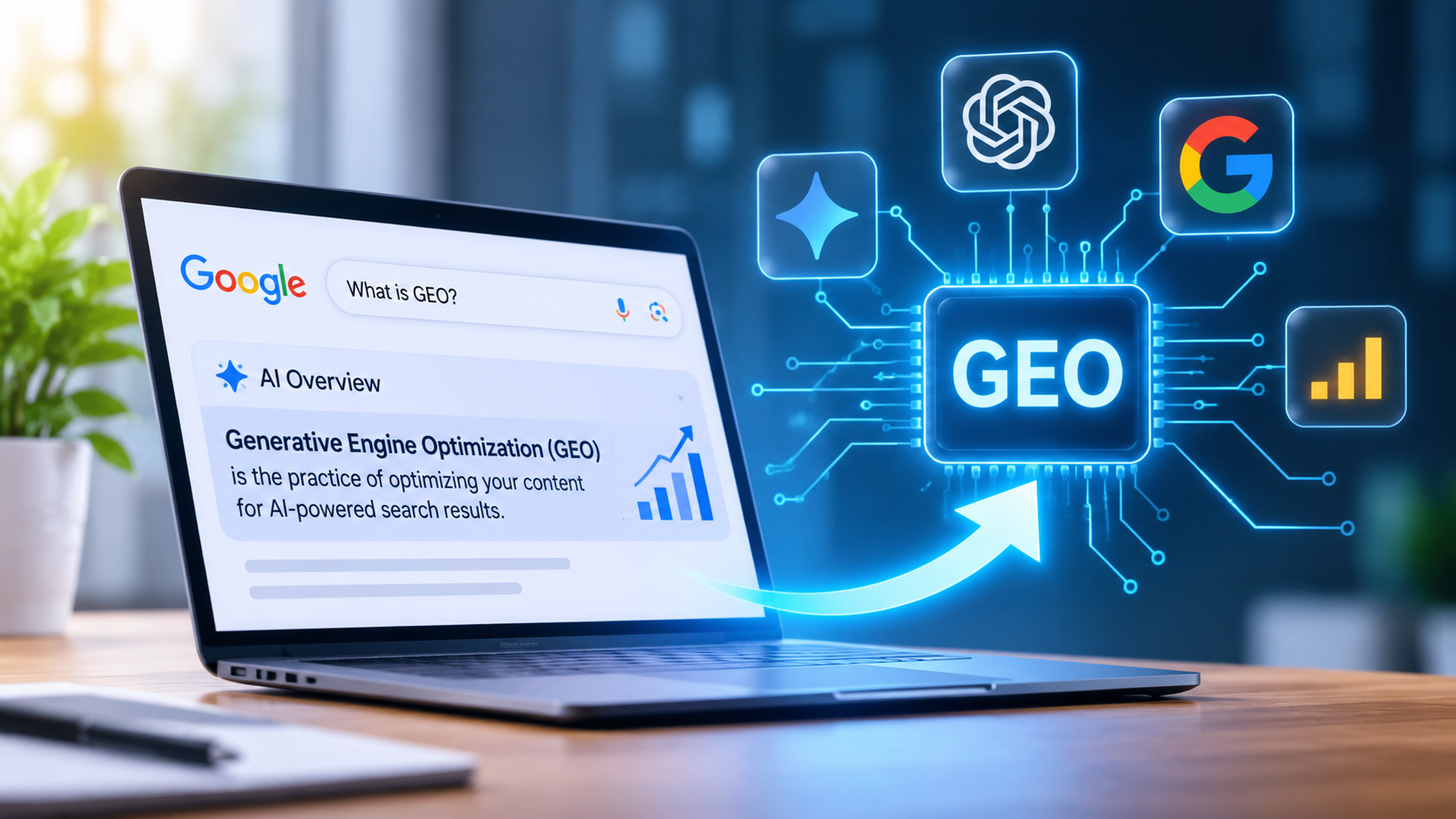
The way people search for information online is changing. Traditionally, users entered a query into a search engine, reviewed a list of links and visited websites to find answers.
Today, people are also using AI-powered platforms to ask questions, compare services, research products and discover businesses. Tools such as ChatGPT, Google's AI search experiences and other generative AI platforms are changing how information is presented and explored.
This shift has created a growing interest in Generative Engine Optimization (GEO).
GEO focuses on improving how clearly a brand, website or business is represented and discovered in AI-generated responses. It complements traditional SEO by considering how AI systems retrieve, interpret and present information.
In this guide, Digital Rank Media explains what GEO means, how it differs from SEO and what businesses can do to improve their visibility across AI-powered search experiences.
1. What Is Generative Engine Optimization (GEO)?
Generative Engine Optimization (GEO) is the practice of improving digital content and brand information so that it can be more easily understood, retrieved, referenced or represented by generative AI systems.
Traditional SEO primarily focuses on improving a website's visibility in search engine results. GEO considers the way AI-powered systems respond to user questions and may use information from websites and other sources to create answers.
For example, a user may ask an AI platform:
-
Which SEO agency can help an eCommerce business?
-
What should I look for when hiring a digital marketing company?
-
Which website development services are suitable for a small business?
-
How can a local business improve its online visibility?
AI systems may generate a response using information available from different sources. GEO aims to make your brand's expertise, services and supporting information clear, useful and accessible.
However, appearing in an AI-generated answer is not guaranteed. Each platform has its own systems, sources and selection processes.
2. Why Is GEO Becoming Important for Businesses?
People are increasingly exploring conversational search experiences to research products, services and solutions.
This creates new considerations for businesses that want to build online visibility.
Here are some reasons why AI search optimization deserves attention:
A. Search behaviour is becoming more conversational
Users may ask detailed questions instead of searching only with short keywords.
For example:
-
Traditional search: SEO agency in Delhi
-
Conversational search: Which SEO agency can help a small business improve organic leads in Delhi?
Businesses should create content that answers relevant questions clearly and comprehensively.
B. Brand discovery is expanding beyond traditional search results
A potential customer may discover a business through an AI-generated answer, a recommendation, a cited source or a follow-up research journey.
This makes it important to maintain consistent and accurate information about your brand across your website and relevant online platforms.
C. Helpful and well-structured content matters
Content should answer real questions, explain concepts accurately and provide useful supporting information.
Clear headings, descriptive page titles, relevant examples and transparent business information can help both people and automated systems understand a website.
D. Businesses need to monitor more than traditional rankings
Traditional keyword rankings remain important, but businesses may also want to understand how their brand appears in AI-powered search experiences.
This includes tracking brand mentions, citations, source references and the accuracy of information presented by AI platforms.
3. What Is the Difference Between SEO and GEO?
SEO and GEO are related, but they are not identical.
SEO focuses on improving a website's visibility in traditional search engine results. GEO focuses on improving the clarity, relevance and accessibility of information that may be used in generative AI responses.
|
Area |
Traditional SEO |
Generative Engine Optimization |
|
Main objective |
Improve search visibility and organic traffic |
Improve brand discoverability and representation in AI-generated answers |
|
Platforms |
Google, Bing and other search engines |
ChatGPT, AI search experiences and other generative platforms |
|
Content approach |
Search intent, relevance, quality and topical coverage |
Clear, useful, well-supported answers and entity context |
|
Measurement |
Impressions, clicks, rankings and conversions |
Brand mentions, citations, source references and referral activity where measurable |
|
Technical focus |
Crawlability, indexability, rendering and structured data |
Accessible content, clear structure and reliable source information |
|
Overall role |
Build organic search visibility |
Complement SEO with AI-oriented visibility efforts |
GEO should not be treated as a replacement for SEO. A strong website foundation, useful content and accurate business information remain important.
4. How Does AI Search Discover and Present Information?
Different AI platforms use different technical systems. Some responses may be generated from a model's existing knowledge, while others may use live web retrieval, search indexes, connected sources or a combination of methods.
A simplified process may involve:
Step 1: User asks a question
A user enters a question or request into an AI platform.
Step 2: The platform interprets the query
The system identifies the topic, intent and relevant information needed to respond.
Step 3: Information is retrieved or selected
Depending on the platform and feature, the system may use its model knowledge, search results, retrieved web pages or other available sources.
Step 4: The response is generated
The AI system creates an answer based on the information available to it.
Step 5: Sources may be referenced
Some platforms display citations or links to sources. Others may provide an answer without showing every source used.
This is why there is no single GEO technique that guarantees inclusion in every AI response.
5. 10 Practical GEO Strategies to Improve AI Search Visibility
Businesses can start improving their readiness for AI-powered discovery by strengthening their website content, technical foundation and brand information.
1. Create Helpful, Question-Based Content
Develop content that addresses the questions your target audience actually asks.
For example, a digital marketing company can publish resources around:
-
How does technical SEO improve website performance?
-
What is the difference between SEO and GEO?
-
How much does eCommerce SEO cost?
-
How can a business improve local search visibility?
-
What should businesses check before hiring an SEO consultant?
Avoid creating multiple pages that repeat the same information. Each article should offer a distinct purpose and useful information.
2. Build Clear and Detailed Service Pages
Your service pages should explain exactly what your business offers.
Include:
-
Service descriptions
-
Target audience and business use cases
-
Process and deliverables
-
Relevant expertise
-
Frequently asked questions
-
Contact information
-
Links to related resources
For example, a GEO service page should explain what GEO involves, how it relates to SEO, what activities are included and how progress may be monitored.
3. Strengthen Your Brand's Entity Information
A brand should be represented consistently across its website and relevant business profiles.
Check that the following information is accurate and consistent:
-
Business name
-
Website URL
-
Contact information
-
Services offered
-
Business description
-
Location, where applicable
-
Founder or author information, where appropriate
Use relevant and trustworthy profiles and directories. Do not create artificial listings or misleading business information just to increase brand mentions.
4. Use Structured Data Where Relevant
Structured data helps search engines understand specific information about a webpage.
Depending on the page, relevant schema types may include:
-
Organization
-
LocalBusiness, where applicable
-
Service
-
Article
-
BlogPosting
-
BreadcrumbList
-
Person
-
WebSite
Implement schema accurately and ensure it reflects visible page content. Structured data does not guarantee AI citations or special search visibility.
5. Improve Website Crawlability and Accessibility
Important content should be accessible to search engines and not hidden behind unnecessary technical barriers.
Review:
-
Robots.txt rules
-
XML sitemaps
-
Canonical tags
-
Indexability
-
JavaScript rendering
-
Internal linking
-
Page loading performance
-
Mobile usability
-
HTTP status codes
-
Important content in the rendered HTML
Check platform-specific documentation before changing crawler access rules. Do not assume that allowing every AI-related bot will automatically improve visibility.
6. Demonstrate Experience and Expertise
Useful content should provide more than generic statements.
Where appropriate, include:
-
Author information
-
Practical explanations
-
Original research or analysis
-
Relevant examples
-
Methodology
-
Supporting references
-
Updated information
If you publish case studies, use real project information and obtain permission where required. Never invent results, clients or performance statistics.
7. Build Relevant Internal Links
Internal linking helps visitors and search systems discover related information.
For example, a blog about GEO can link to:
-
SEO services
-
Technical SEO
-
eCommerce SEO
-
Local SEO
-
Contact page
Use descriptive anchor text that explains the destination page. Avoid forcing exact-match keywords into every link.
8. Keep Business Information Accurate Across the Web
Review your website, business profiles and other relevant public sources to ensure they describe your brand consistently.
Outdated phone numbers, conflicting service descriptions and inaccurate company details can create confusion for potential customers.
Prioritise legitimate, relevant platforms rather than chasing large numbers of low-quality directory listings.
9. Optimise Content for Clarity and Readability
A useful content structure can make information easier to understand.
Consider using:
-
One clear H1 per page
-
Descriptive H2 and H3 headings
-
Short, focused paragraphs
-
Tables for comparisons
-
Step-by-step explanations
-
Relevant FAQs
-
Definitions for technical terms
-
Sources for factual claims
Write for people first. Do not create unnatural content simply to insert phrases such as ChatGPT SEO, AI SEO or GEO repeatedly.
10. Monitor AI Search Visibility
GEO measurement is still developing, and there is no universal AI ranking report that works across all platforms.
You can build a repeatable monitoring process:
-
Identify relevant questions your customers may ask.
-
Test those questions across selected AI platforms.
-
Record whether your brand is mentioned.
-
Check whether your website is cited or linked.
-
Review the accuracy of the information presented.
-
Track changes over time using the same prompts.
-
Compare AI referral traffic and conversions where analytics data is available.
Keep in mind that responses may vary by user, location, platform, model and time. A small set of manual checks should not be treated as a definitive ranking measurement.
6. How Can Digital Rank Media Help with SEO and GEO?
At Digital Rank Media, we recognise that businesses need a strong digital presence across traditional search and emerging AI-powered discovery experiences.
Our approach combines SEO fundamentals with practical GEO considerations.
Our services and activities can include:
-
SEO audits and technical recommendations
-
Keyword research and search intent analysis
-
Content strategy and optimisation
-
Service page and website structure improvements
-
Internal linking recommendations
-
Structured data implementation guidance
-
Local SEO and business information optimisation
-
eCommerce SEO
-
AI search visibility analysis
-
Brand and content consistency reviews
We focus on understanding your website, target audience and business objectives before recommending improvements.
Whether you are looking to strengthen your Google organic visibility or explore Generative Engine Optimization services, Digital Rank Media can help you plan a practical approach.
Want to improve your website's search visibility? Visit Digital Rank Media or contact our team to discuss your SEO and GEO requirements.
7. Common GEO Mistakes Businesses Should Avoid
While exploring GEO, businesses should avoid tactics that focus on shortcuts rather than useful information.
Common mistakes include:
-
Publishing AI-generated articles without checking facts or adding value.
-
Repeating the same keywords unnaturally.
-
Creating multiple pages with almost identical content.
-
Buying irrelevant backlinks or artificial brand mentions.
-
Adding schema that does not match visible page content.
-
Assuming that a specific AI crawler setting guarantees citations.
-
Treating one AI response as proof of ranking performance.
-
Making unsupported claims about being recommended by AI platforms.
A sustainable approach focuses on accuracy, useful content, accessible websites and trustworthy brand information.
Final Thoughts
Generative AI is creating new ways for people to discover and evaluate businesses. This makes it important to think beyond traditional keyword rankings and build a clear, useful and trustworthy digital presence.
A practical Generative Engine Optimization strategy starts with strong SEO foundations, helpful content, accurate brand information, technical accessibility and consistent measurement.
For businesses looking to strengthen their organic search presence and prepare for changing discovery experiences, Digital Rank Media can help plan SEO and GEO improvements around real business objectives.
Frequently Asked Questions
What is Generative Engine Optimization (GEO)?
Generative Engine Optimization is the practice of improving website content and brand information so that generative AI systems can better understand, retrieve, reference or represent it in AI-generated responses.
What is the difference between SEO and GEO?
SEO focuses on improving visibility in traditional search engine results. GEO focuses on how a brand's information may be discovered and represented in generative AI responses. Both approaches can complement each other.
Is GEO replacing traditional SEO?
No. GEO is not a replacement for traditional SEO. Technical accessibility, useful content, search relevance and a strong website structure remain important foundations for online visibility.
How can I optimise my website for ChatGPT?
Start by publishing accurate and useful content, maintaining accessible webpages, building clear service information, improving internal linking and keeping your brand details consistent. AI platform behaviour varies, so no technique guarantees that ChatGPT will mention or cite a particular website.
What is AI SEO?
AI SEO is a broad term used for SEO practices that consider AI-powered search experiences, generative search systems and AI-assisted workflows. It may include GEO, content optimisation, technical SEO and monitoring AI search visibility.
Does structured data help with GEO?
Structured data can help search engines interpret specific information about a webpage. It should be implemented accurately and reflect visible content. However, adding schema does not guarantee that an AI platform will cite or recommend your business.
How can I track GEO performance?
Monitor a consistent set of relevant questions across selected AI platforms. Record brand mentions, citations, linked sources and factual accuracy. Where available, also review AI referral traffic and conversions in your analytics platform.
What type of content is useful for GEO?
Helpful content includes detailed service pages, educational articles, original research, comparisons, practical guides, clearly answered questions and trustworthy business information. The content should be accurate and genuinely useful to the intended audience.
Do I need a separate GEO strategy if I already do SEO?
You may not need an entirely separate strategy. Many GEO activities build on good SEO practices. However, it can be useful to add AI visibility monitoring, question-based content planning and brand information checks to your existing SEO programme.
Can Digital Rank Media help with GEO services?
Digital Rank Media can help businesses review their website content, SEO foundations, brand information and AI search visibility opportunities. The recommended activities depend on the website, industry and business goals.